Kinetic Span

Rainwater Harvesting for Industries

A factory uses water the way it uses power: constantly, and mostly out of sight. Cooling towers, equipment washdown, floor cleaning, process lines, landscaping and the canteen all draw on the same supply. When that supply gets tight, the whole plant feels it.

For a lot of industrial sites, that squeeze is already here. Borewells yield less than they used to. Tanker bills climb. Groundwater rules get stricter. In those conditions, harvesting rainwater stops being a nice extra and becomes a sensible part of running the plant.

Kinetic Span designs high-capacity rainwater harvesting systems for factories, warehouses and industrial parks. The idea is simple. Your buildings have enormous roofs, and every monsoon those roofs shed more rainwater than most people expect. We catch it, clean it, and either store it for reuse or send it back into the ground. How we do that depends on your site, and the sections below explain how.

Industrial rainwater harvesting system

Every roof is an opportunity to capture water.

The reality for industry

Industry Challenges

01

Water scarcity

Ask a plant manager about water and you’ll often get a sigh. Borewells that once gave a steady yield now give less, or run dry in summer. Tankers fill the gap at a price that moves with the season and the supplier. Every tanker is a cost, a scheduling headache and a risk to production if one doesn’t turn up on time.

02

Regulatory pressure

Authorities are paying closer attention to who takes water from the ground and what they put back. Groundwater extraction limits, recharge requirements from bodies like the CGWA and environmental clearances all push industry towards managing water more responsibly. Falling short can mean delays, penalties or trouble when you want to expand. It’s far easier to sort out before it becomes urgent than after.

03

Corporate responsibility

Investors, customers and lenders increasingly ask how a company handles water. ESG reports no longer get by on good intentions. They want figures you can stand behind: how much water you use, where it comes from and what you’re doing to reduce the strain on public supply. A harvesting system gives you real numbers to put in front of them.

Built around your site

Our Industrial Solutions

Every site is different, so we don’t sell a fixed package. We work from a toolkit and pick the parts that fit your roof, your soil and your water use. Here’s what’s in it.

01

Large-scale collection

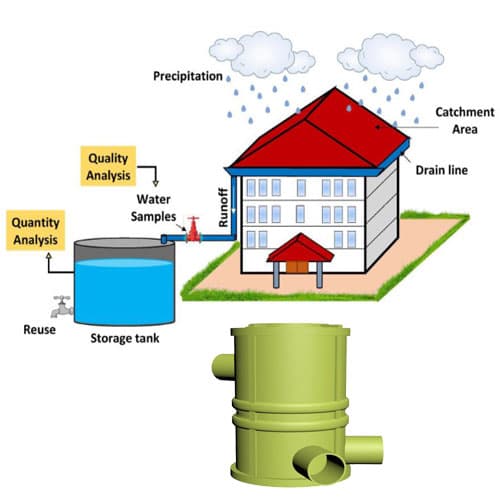
Factory roofs are some of the best catchments there are, and we put them to work. We channel runoff through engineered conveyance systems, with gutters, downpipes and drains sized for heavy monsoon downpours instead of a light shower. The aim is to get as much of the rain as possible to the next stage without overflows or leaks along the way.

02

High-capacity filtration

Roofs at industrial sites collect dust, grit and whatever else settles from the air around them. Before water reaches storage or a recharge structure, it passes through filtration built for that load. Clean water going in means less maintenance, longer equipment life and water that’s actually useful once you want to draw on it.

03

Modular recharge units

When there’s more rain than you can store, or when recharge is what the regulations call for, we build recharge wells, pits and other subsurface structures that let excess water soak into local aquifers quickly. They’re designed to your site’s soil and capacity, and they’re built so they don’t silt up in a couple of seasons.

04

Storage reservoirs

Where it makes sense, we add underground tanks and reservoirs to hold water for non-potable uses such as irrigation and cooling towers. Stored water also acts as a buffer. Instead of watching the monsoon run away and then scrambling in April, you’ve got something to draw from.

05

Turnkey compliance

Our designs follow the government guidelines that apply to your project, including CPWD and Smart City norms, and we help with the paperwork too. You get the documentation to show an auditor, an authority or a certification body, so you’re not rebuilding the paper trail after the fact.

You can read more on our Rainwater Harvesting System and Rainwater Harvesting Installation Company pages.

The potential above your head

What Could a Factory Roof Give You?

It helps to put a number on it. Imagine a factory with 10,000 square metres of roof in a place that gets 700 mm of rain a year. One millimetre of rain on one square metre is one litre, and a well-kept catchment captures roughly 80% of it. That comes to about 56 lakh litres a year, or around 560 tanker loads of 10,000 litres each.

Estimated annual rainwater potential

56 lakh

litres per year

10,000

Square metres of roof

700 mm

Annual rainfall

80%

Catchment efficiency

560

Tanker loads of 10,000 litres each

It’s a rough sum, not a promise. Real figures depend on rainfall records, roof materials and how the catchment is laid out. But it shows why industrial roofs are worth taking seriously, and why we start every project with a proper survey instead of guesswork.

The value of harvesting

Benefits

01

Less dependence on groundwater.

Recharging the aquifer helps sustain well yields. You stop treating your borewell as a bottomless account and start putting something back.

02

Real cost savings.

Every litre you collect is one you don’t buy. Lower tanker fees and less power spent on pumping both show up on the bill, and they keep showing up year after year.

03

Easier regulatory compliance.

We design to the central and state water authority norms that apply to your site. A working system with proper documentation turns an awkward conversation with an authority into a short one.

04

Stronger ESG and green ratings.

Harvesting gives you measurable figures for sustainability reporting, and it can contribute towards green building certifications such as IGBC and GRIHA. These numbers help in CSR reports, investor conversations and customer audits.

05

A dependable supply.

Stored rainwater cushions you against dry spells and delivery problems. It won’t replace every source, but it makes production less hostage to the weather and the tanker schedule.

06

Better for the site and the surroundings.

Capturing runoff reduces flooding on your own premises and sends more water into the ground, which improves local groundwater tables over time.

Across sectors

Industries Served

We work with industrial sites of many kinds, and each has its own water story.

01

Manufacturing and engineering plants.

Heavy industry needs a lot of process water, and big plants tend to have big roofs. It’s an obvious match.

02

Warehouses and logistics hubs.

These sites often have enormous roof areas and relatively modest water demand, which makes them ideal for collection and recharge.

03

Food and beverage facilities.

Hygiene comes first. We design storage and filtration with equipment washdown and cleaning in mind, so the water you reuse is fit for the job.

04

Chemical and pharmaceutical plants.

Storage and safety requirements are stricter here, and any runoff that could be contaminated needs extra care. We design around your safety team’s requirements, not over them.

05

Textile and dyeing units.

Few industries use water as heavily, so every litre reclaimed makes a noticeable difference.

06

Automotive and engineering units.

Vehicle washing and cooling are good candidates for reusing harvested water.

07

Technology campuses.

Corporate and IT parks often have green building goals, and harvesting fits naturally into the design from the start.

Whatever the sector, every system is tailored to the site’s layout, local rainfall and the way it actually uses water.

Common questions

FAQs

01Can a rainwater system handle polluted runoff?+

Our systems are built around clean roof runoff. If roof runoff is contaminated, as it can be at chemical plants, we may need extra pre-treatment or a way to divert it so it doesn’t reach your storage tanks. We’ll look at this during the survey so there are no surprises later.

02How do we know we’ll meet legal recharge requirements?+

Our engineers calculate recharge pit and tank capacity from the relevant guidelines. We also carry out soil percolation tests, so recharge structures are sized to how your ground actually takes water, not to a textbook assumption.

03Does harvesting rain qualify for carbon or sustainability credits?+

Rainwater harvesting contributes to sustainability goals, mainly by reducing your water footprint. Whether it earns specific credits depends on the certification body and its rules. What we can do is provide the documentation you’ll need for green building certifications.

04Can we use harvested rainwater in our processes?+

That depends on the process. Harvested rainwater is usually used for non-potable purposes such as cooling towers, washing, cleaning and irrigation. If you have a particular use in mind, tell us early, and we’ll match the filtration and storage to what it needs.

05Can we add a system to a plant that’s already running?+

Often, yes. We look at your roof, drainage and available space, and plan the work around your production schedule. Retrofits take a bit more thought than new builds, which is why the site survey matters so much.

Start with your site

Let’s Look at Your Roof

If you run a plant and wonder what rainwater harvesting could do for you, we’d be glad to help. Start with a free consultation. We’ll walk your site, run the numbers and tell you honestly what’s possible. Contact Us to book, or see the full range of what we offer on our Services Overview page.